
Search products
By name, colour, finish or material — “Bianco Carrara”, “travertine”, “honed”.
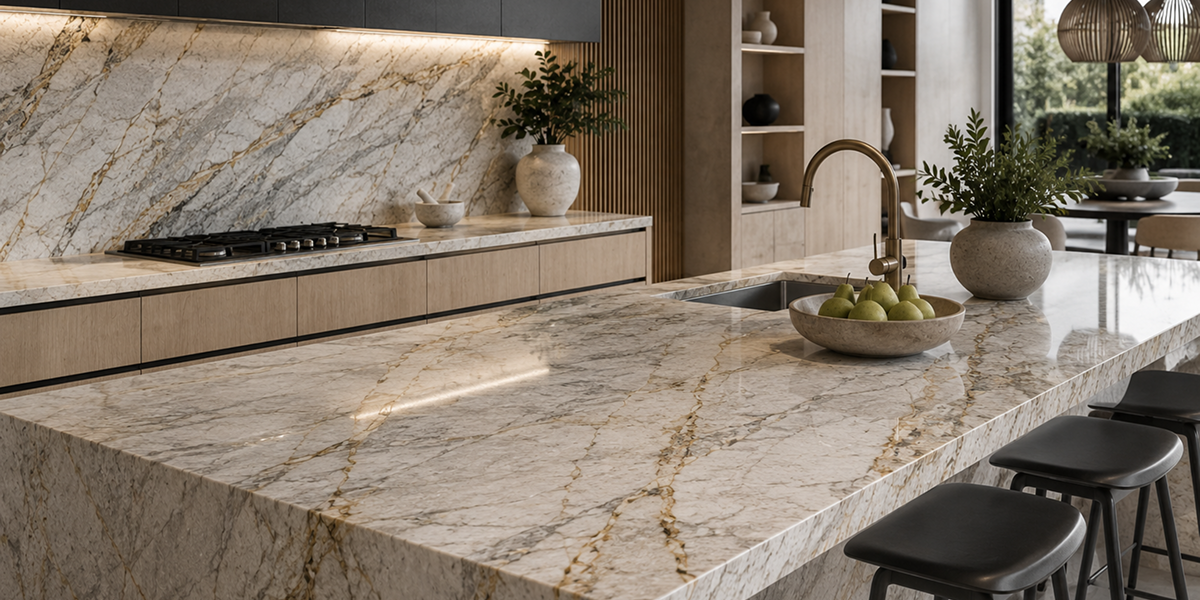
Quartzite has become one of the most sought-after natural stones for kitchen benchtops in Australia, particularly among homeowners who want distinctive natural movement combined with the performance of a hard stone surface.
But quartzite is also one of the most misunderstood benchtop materials.
Search online and you will find conflicting claims about whether quartzite stains, whether it needs sealing, whether it can etch and even whether it is the same thing as quartz.
Genuine quartzite can be an excellent choice for a kitchen benchtop because it is a hard, quartz-rich natural stone. However, the individual slab, its porosity, finish, sealing requirements, fabrication and correct identification all matter.
This guide explains the pros and cons of quartzite benchtops, maintenance, staining, sealing, cost factors, Taj Mahal quartzite and what Australian homeowners should check before choosing a slab.
Quartzite is a naturally occurring metamorphic rock.
It begins as quartz-rich sandstone. Over geological time, intense heat and pressure cause the quartz grains within the sandstone to recrystallise and bond together, forming a much denser and harder stone.
Because quartzite is natural rather than manufactured, every slab is different.
Depending on its mineral composition, quartzite can contain white, cream, beige, grey, green, blue, gold, pink, brown and other tones, with veining ranging from subtle movement to dramatic patterns.
This variation is one of the main reasons quartzite is popular for statement kitchen islands, splashbacks and architectural surfaces.
You can browse StoneMart's natural stone slabs to compare quartzite with other natural stone options.
No. Quartzite and engineered quartz are completely different materials.
Quartzite is a natural stone quarried directly from the earth.
Traditional engineered quartz surfaces were manufactured using mineral material combined with resins and other constituents.
The similar names cause a great deal of confusion online, particularly when people research cleaning, heat resistance, sealing and maintenance.
If you are considering natural quartzite, make sure the advice you are reading relates specifically to quartzite rather than engineered quartz.
Yes. Suitable genuine quartzite can be an excellent kitchen benchtop material because it combines high hardness with the visual variation of natural stone.
It can work particularly well in kitchens where the benchtop is intended to become a major design feature rather than simply a neutral work surface.
Quartzite may suit homeowners who want:
However, no premium natural stone should be selected purely from photographs. Inspecting the actual slab and understanding its care requirements is an important part of the selection process.
Quartzite offers an appealing combination of appearance and durability, but it is not maintenance-free.
Genuine quartzite is a hard natural stone and is well suited to heavily used surfaces such as kitchen benchtops.
Quartzite is composed predominantly of quartz, a hard mineral that helps give the stone strong resistance to everyday scratching and wear.
That does not mean a quartzite benchtop is indestructible.
Using cutting boards, trivets and sensible cleaning products remains good practice for any premium natural stone installation.
Edges and cut-outs also deserve care because impact around exposed edges can damage even a very hard stone.
Quartzite can potentially stain, but the likelihood depends on the individual stone, its porosity, finish, sealing and how quickly spills are cleaned.
This is one of the biggest concerns homeowners have when researching quartzite.
Liquids such as cooking oil, coffee, wine and strongly coloured foods should not be intentionally left sitting on a natural stone surface for long periods.
Good everyday habits include:
A suitable impregnating sealer can help reduce liquid absorption, but sealing should not be interpreted as making a benchtop completely stain-proof.
A dark mark that appears after water sits on natural stone may sometimes be moisture entering the stone, particularly if the surface is absorbent or the protection provided by a sealer has diminished.
However, not every visible mark is caused by the same thing.
Water absorption, oil staining, cleaning residue and surface changes can look similar to an untrained eye.
This is why a persistent mark should be correctly identified before aggressive cleaning products or restoration methods are used.
If you notice repeated darkening around a sink, tap or other wet area, discuss the condition of the stone and sealer with your supplier, fabricator or natural stone specialist.
Many quartzite benchtops benefit from an appropriate impregnating sealer, but there is no single sealing rule that applies to every quartzite slab.
The requirement depends on factors including:
This is why you may find contradictory advice online saying quartzite should be sealed every few months, every year or only when necessary.
Rather than following a generic timetable, follow the recommendations given for the specific stone and sealing product used on your benchtop.
Quartzite should be resealed based on the condition and absorbency of the actual surface rather than automatically according to a fixed annual schedule.
Different sealers have different service lives, and different quartzites absorb liquids at different rates.
A benchtop in a heavily used family kitchen may also behave differently from the same stone installed on a lightly used bathroom vanity.
Your fabricator, supplier or sealer manufacturer should be able to advise when reassessment is appropriate.
True quartzite is composed predominantly of quartz and is generally resistant to the acid etching associated with calcite-rich stones such as marble.
This question is important because some stones sold commercially as quartzite may actually be different geological materials.
If a stone marketed as quartzite reacts strongly to common household acids, it may be worth confirming its geological composition.
Correct identification is therefore an important part of buying natural stone.
Regardless of stone type, avoid using acidic cleaners unless the product is specifically approved for the surface.
Quartzite has good natural heat resistance, but StoneMart would still recommend using a trivet or heat-resistant mat under very hot cookware.
There is little benefit in placing extreme heat directly onto an expensive benchtop when a simple trivet provides additional protection.
It also helps protect the surface from residues on cookware and reduces unnecessary thermal stress.
Quartzite is hard enough that direct cutting may damage your knife blades before it damages the stone.
Nevertheless, using a cutting board is recommended.
A cutting board protects the benchtop from trapped grit, dragged cookware and unnecessary wear while also protecting your kitchen knives.
Routine quartzite maintenance should be simple.
For normal cleaning:
Avoid assuming that a cleaner designed for another kitchen surface is automatically suitable for natural stone.
There is no single standard price for a quartzite benchtop in Australia because the final project cost depends on the slab, fabrication and installation requirements.
Quartzite is generally positioned as a premium natural stone, and some rare or highly expressive varieties command considerably higher prices than more readily available materials.
The finished cost can depend on:
This is why comparing the advertised price of a slab with the complete price of a fabricated and installed benchtop can be misleading.
For a more detailed explanation, read our Stone Benchtop Cost Australia guide.
Taj Mahal Quartzite is popular because its warm cream, beige and soft natural veining work well with many contemporary Australian kitchen palettes.
Rather than creating an extremely bold statement, Taj Mahal can provide natural movement while remaining relatively understated.
It works particularly well alongside:
StoneMart currently offers different Taj Mahal quartzite slabs, including Taj Mahal Quartzite NO1 and other available Taj Mahal selections.
Because it is natural stone, the colour and movement of one Taj Mahal slab can differ from another. Inspecting the actual slab before fabrication is therefore important.
Quartzite is much broader than white and beige.
Depending on the minerals present during formation, quartzite can contain dramatic greens, blues, pinks, greys, creams and multi-coloured movement.
StoneMart's quartzite selection includes distinctive stones such as Patagonia Quartzite, Emerald Haze Quartzite, Explosion Blue Quartzite, Krypton Quartzite and Negresco Quartzite.
You can view StoneMart's natural stone slab collection to compare available options.
Quartzite is generally the better choice when hardness and resistance to acid etching are priorities, while marble may be preferred when its particular veining and natural patina are the main attraction.
Marble contains calcite and can etch when exposed to common kitchen acids such as lemon juice or vinegar.
Genuine quartzite is predominantly quartz and behaves differently.
That does not make marble unsuitable for kitchens. Many homeowners deliberately choose marble because they love how it looks and are comfortable with the surface developing patina over time.
If you are comparing several natural stones, read our guide to the best natural stone for kitchen benchtops in Australia.
Both granite and quartzite can make excellent kitchen benchtops.
Granite has a long history as a durable kitchen surface and is available in an enormous range of mineral patterns and colours.
Quartzite has become particularly popular with homeowners seeking flowing natural movement similar to some marbles while retaining the characteristics of a hard quartz-rich stone.
The better option depends on the actual slabs you are comparing, your preferred appearance and your expectations around maintenance.
Australia prohibited work involving the manufacture, supply, processing and installation of engineered stone benchtops, panels and slabs from 1 July 2024 under the national engineered stone prohibition.
This increased consumer interest in alternative kitchen surface materials, including natural stone and eligible porcelain or sintered products.
Natural quartzite should not be confused with the engineered stone products covered by the prohibition.
Quartzite is naturally formed and quarried from the earth.
The finish affects both how quartzite looks and how the surface interacts with light.
A polished finish produces greater reflection and can emphasise colour, depth and natural veining.
A honed finish has a softer, lower-sheen appearance and may suit contemporary interiors where a more understated surface is preferred.
Finish can also affect the way fingerprints, moisture and everyday residue appear, so it is worth viewing physical samples before making a decision.
Before approving a quartzite slab, ask your stone supplier or fabricator:
These questions can prevent misunderstandings after the stone has already been cut.
Yes. Whenever possible, select natural stone from the actual slab rather than relying only on a small sample or online photograph.
A small sample cannot show the full pattern, major veins, mineral changes or overall movement that may become very prominent across a large kitchen island.
Viewing the slab also allows you to discuss possible seam locations and vein placement before fabrication begins.
StoneMart supplies natural stone from Melbourne and offers a range of quartzite slabs for kitchen benchtops, islands, splashbacks, bathrooms and architectural projects.
If you are choosing a feature stone, viewing the available slab can help you understand its colour, veining and scale much better than viewing a small sample online.
Contact StoneMart to discuss current quartzite availability or arrange to compare suitable natural stone options for your project.
Quartzite can be worth the investment for homeowners who want genuine natural stone, distinctive veining and strong everyday durability.
It is particularly attractive when the benchtop or island is intended to become a major visual element of the kitchen.
However, quartzite is not necessarily the best choice for every project.
If you want an entirely uniform surface or expect a premium benchtop to require no care whatsoever, another material may suit your expectations better.
The right decision comes from balancing appearance, maintenance, budget and how your kitchen is actually used.
Yes. Genuine quartzite is a hard natural stone and can be an excellent material for kitchen benchtops. The individual slab, finish, porosity and sealing requirements should still be considered before purchase.
Not necessarily, but quartzite can potentially absorb liquids depending on the individual stone and its porosity. Appropriate sealing and cleaning spills promptly can help reduce the risk of staining.
Many quartzite benchtops benefit from an appropriate impregnating sealer. The requirement and resealing interval depend on the actual stone, finish, sealer and level of use.
There is no universal schedule. Rather than automatically resealing every year, follow the recommendations for the specific slab and sealing system and reassess the surface when necessary.
Some natural stones can temporarily darken when moisture is absorbed. Persistent marks can also have other causes, so the problem should be correctly identified before aggressive cleaners or restoration methods are used.
Genuine quartzite has strong scratch resistance because of its high quartz content, but cutting boards and normal protective habits are still recommended.
Quartzite has good heat resistance, but using trivets or heat pads remains the safest approach for protecting a premium benchtop over the long term.
Genuine quartzite is generally harder and more resistant to acid etching than calcite-based marble. However, individual natural stones still need to be assessed according to their actual composition and finish.
Yes. Taj Mahal Quartzite is commonly selected for kitchen benchtops because of its warm neutral colouring, natural movement and quartzite characteristics. As with any natural slab, inspect the actual piece and discuss sealing and fabrication requirements before installation.
The final cost depends on the particular quartzite, number of slabs, fabrication, cut-outs, edge profiles, waterfalls, splashbacks, installation and project complexity. A project-specific quote is more meaningful than a single generic price per square metre.
Quartzite works best when it is chosen as both a practical surface and a natural material.
Don't simply ask whether quartzite is good or bad.
Ask whether the particular slab suits your kitchen, your design, your maintenance expectations and the way your household uses the space.
Inspect the actual stone where possible, understand its sealing requirements, discuss vein placement with your fabricator and make sure you know exactly what is included in the finished benchtop quote.
To start comparing materials, explore StoneMart's natural stone slabs, view our completed projects, or contact StoneMart to discuss quartzite for your kitchen or upcoming project.
Showcase
Explore stunning interiors and exteriors showcasing premium marble, granite, travertine, limestone, and porcelain in beautifully designed spaces