
Search products
By name, colour, finish or material — “Bianco Carrara”, “travertine”, “honed”.
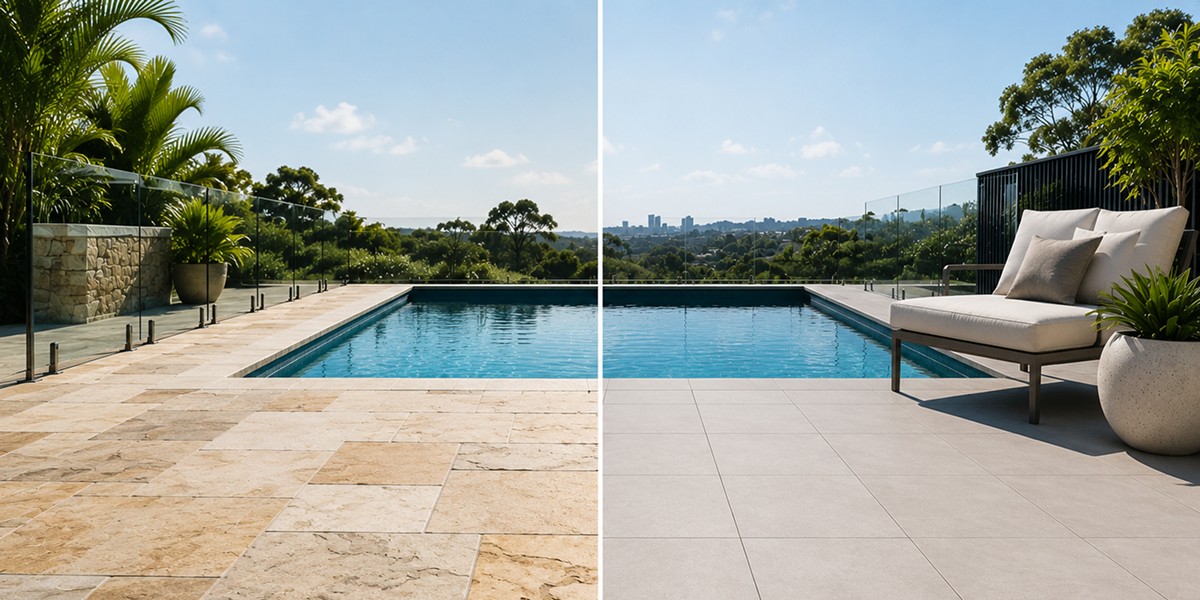
Choosing a material for your swimming pool surrounds involves much more than selecting a colour. Pool pavers must handle water, direct sunlight, changing weather, foot traffic, leaves, dirt and the products used to maintain the pool.
Natural stone and porcelain are two popular choices for Australian outdoor areas. Natural stone provides genuine variation and character, while porcelain offers a more controlled appearance and generally straightforward maintenance.
Neither option is automatically better for every property. The right decision depends on the exact product, colour, surface finish, available testing, installation system and the amount of maintenance you are prepared to undertake.
This guide compares natural stone and porcelain pool pavers across appearance, heat, wet-area grip, sealing, staining, coping and long-term maintenance.
| Consideration | Natural stone | Porcelain |
|---|---|---|
| Appearance | Genuine colour, texture and natural variation | Consistent manufactured appearance |
| Individuality | Every piece is different | More uniform across the installation |
| Maintenance | May require sealing and material-specific cleaning | Generally lower maintenance |
| Stain resistance | Depends on the stone, finish and sealer | Generally resistant to many everyday stains |
| Wet-area grip | Depends on the stone and surface finish | Selected outdoor products may have documented slip classifications |
| Heat underfoot | Depends heavily on colour, finish and sun exposure | Also depends on colour, finish and exposure |
| Pool coping | Available in bullnose, drop-face and other profiles | Matching manufactured coping may be available in selected ranges |
| Design character | Organic and distinctive | Controlled and contemporary |
This is a general comparison. Always review the technical information for the exact product rather than relying only on whether it is described as natural stone or porcelain.
Natural stone is formed rather than manufactured, so every piece has its own tonal movement, veining and texture. This variation is one of its strongest design qualities.
Travertine, limestone and selected marble products can create a pool area that feels integrated with the surrounding landscape. Natural stone can work particularly well with gardens, rendered walls, timber elements and other organic materials.
Explore StoneMart’s natural stone collection or browse the pool coping tiles collection.
No two pieces of natural stone are exactly alike. A finished area may contain changes in colour, fossils, veins, pores and other characteristics created during the stone’s formation.
These differences should be treated as part of the material rather than defects. Viewing several samples, or preferably a representative range, provides a better understanding than choosing from one small piece.
If you are new to stone terminology, read StoneMart’s guide to the different types of natural stone.
Travertine is frequently considered for swimming pools, courtyards and outdoor entertaining areas because of its warm tones and textured finishes.
Products such as Hierapolis Travertine Paver Tumbled demonstrate the softer edges and aged character associated with a tumbled finish.
Travertine is naturally porous. Its finish, fill, thickness, installation system and sealer must all be considered for the intended location. Ask whether the exact product is suitable for your pool environment rather than assuming every travertine product performs identically.
Pool coping forms the edge between the pool and the surrounding paving. Its profile affects both the finished appearance and how the edge feels under hand and foot.
Natural stone coping may be available with bullnose, rebated or drop-face profiles. Examples in the StoneMart collection include Classic Travertine Bullnose 30mm and Classic Travertine Drop Face.
Confirm dimensions, edge profiles, availability and suitability before finalising the pool design.
Porcelain pavers are manufactured under controlled conditions. This can provide greater consistency in dimensions, colour and surface texture than natural stone.
For homeowners who prefer a coordinated finish with less natural variation, porcelain can be an attractive option. It may also suit projects where straightforward cleaning and consistent product specifications are priorities.
Explore StoneMart’s porcelain collection and porcelain paver range.
Porcelain can reproduce stone-inspired colours while maintaining a more controlled overall appearance. This may suit contemporary pools with clean architectural lines and a restrained colour palette.
Before selecting a stone-look porcelain product, view several pieces together. Check how frequently the pattern repeats, how the edges are finished and whether the variation looks convincing across a larger area.
Selected outdoor porcelain products may be supplied with documented technical classifications. Ask for test information applying to the exact product and finish being considered.
The National Construction Code refers to slip-resistance classifications tested under AS 4586 for certain exposed stairs, ramps and landings. This does not mean one rating automatically applies to every residential pool deck, but it demonstrates why written test evidence is more useful than a broad “non-slip” description.
The final selection should be reviewed with the supplier, installer and, where required, the relevant building professional.
Paradigm Grey Porcelain Pavers are one example from StoneMart’s current porcelain range. Confirm suitability and technical documentation for your particular pool environment before ordering.
There is no universal answer based only on the words natural stone or porcelain.
Surface temperature can be affected by:
Darker surfaces generally absorb more solar energy and may feel hotter in direct summer sun. A light-coloured product can therefore be a sensible starting point, but representative samples should still be assessed under realistic conditions.
If heat underfoot is important, place samples in full sun at the property and compare them during the hottest part of the day. Do not base the decision on showroom temperature alone.
A pool surround is expected to become wet, so the exact surface finish is crucial.
Highly polished surfaces are generally not the starting point for an exposed pool deck. Textured, tumbled, sandblasted or purpose-made outdoor finishes may provide more appropriate surface characteristics, depending on the product.
Visual texture alone does not prove performance. Two products that look similar can behave differently when wet.
Ask the supplier for:
Natural stone can also be tested, but variation between pieces and finishes must be considered. Avoid claims that all natural stone is slippery or that every porcelain paver is automatically safe.
Installation also matters. Drainage, falls, joints, surface contamination and ongoing cleaning can affect how a completed pool area performs.
Many natural stones may benefit from a suitable penetrating or impregnating sealer, but the requirements vary by stone and application.
A sealer should not be presented as making stone completely waterproof or stainproof. It generally improves resistance to staining, giving the owner more time to clean spills and contaminants.
Before applying a sealer, confirm:
Always test the complete cleaning and sealing system on a spare piece or inconspicuous area first.
StoneMart carries a selection of stone care and sealant products, including Sure Seal Premium Plus Sealer and Lithofin MN Stain Stop.
Product suitability must be confirmed for the selected stone, finish and pool environment before application.
Porcelain itself generally does not require the same sealing approach as porous natural stone. However, the complete installation includes joints, grout, edges and surrounding materials, which may have separate care requirements.
Some porcelain products or installation systems may require special treatment during installation or cleaning. Follow the manufacturer’s documentation rather than assuming every porcelain surface is maintenance-free.
Pool surrounds are exposed to sunscreen, food, drinks, soil, wet leaves, metal furniture and pool water.
Some natural stones, particularly calcareous stones such as marble, limestone and travertine, can be affected by acidic cleaning products. Use a cleaner recommended for the exact surface and avoid experimenting with vinegar, lemon or harsh household products.
Helpful maintenance habits include:
For suitable maintenance products, browse StoneMart’s stone care and sealant range.
A pool environment involves more than the surface material. Water chemistry, splash exposure, coping details, drainage, adhesives, grout, movement joints and sealers must function as a complete system.
Do not assume a product is suitable for saltwater or chlorinated water simply because it is marketed for outdoor use.
Ask for written confirmation covering:
This is particularly important at the waterline and coping, where repeated wetting and drying creates different conditions from the rest of the paving.
A premium product cannot compensate for unsuitable preparation or installation.
The installer should account for:
Use an installer experienced with the chosen material. Natural stone and porcelain may require different cutting, handling and installation methods.
Order enough material for the planned layout, cuts, breakage and future repairs. Confirm the recommended allowance with the supplier and installer because it varies by pattern and project complexity.
Natural stone may suit your project when:
Porcelain may suit your project when:
Choose natural stone if you value authentic variation, organic character and a material that makes every pool area unique, and you are prepared to follow the appropriate care process.
Choose porcelain if you prefer consistency, lower day-to-day maintenance and access to repeatable manufactured finishes and product documentation.
Neither category wins automatically. A light, textured and correctly specified product may be more suitable than a dark or highly polished alternative, regardless of whether it is natural stone or porcelain.
The safest decision comes from comparing actual samples, reviewing the relevant technical information and treating the paver, coping, installation products, drainage and maintenance plan as one complete system.
Selected travertine products and finishes are commonly considered for pool surrounds. Suitability depends on the exact stone, finish, fill, thickness, installation, water exposure and maintenance system. Confirm the product’s intended application before ordering.
Performance depends on the exact porcelain product and surface finish. Ask for wet slip-resistance test information rather than relying only on descriptions such as textured, outdoor or non-slip.
Not every stone or application has identical requirements. Many porous stones may benefit from a compatible impregnating sealer, but sealing improves stain resistance rather than making stone completely stainproof.
Colour, finish, density, exposure and installation all influence surface temperature. Lighter colours are generally a logical starting point, but representative samples should be tested in direct sun at the property.
Natural stone usually requires more material-specific care and may require sealing. Porcelain is generally lower maintenance, although grout, joints and the complete installation still require cleaning and care.
Not automatically. Pool coping requires suitable dimensions and an appropriate edge profile. Confirm whether the selected range includes matching bullnose, rebated or drop-face pieces designed for the proposed installation.
There is no universal material choice. Confirm compatibility across the paver, coping, adhesive, grout, jointing material, sealer and cleaning system. Obtain written advice for the exact products being considered.
Still deciding between natural stone and porcelain for your pool area?
Explore StoneMart’s natural stone, porcelain and pool coping collections.
For product samples, availability and help comparing suitable finishes, contact StoneMart.
This article provides general material-selection information. Product suitability, slip resistance, installation, sealing and regulatory requirements must be confirmed for the specific product, property and application with the relevant supplier, installer and building professional.
Showcase
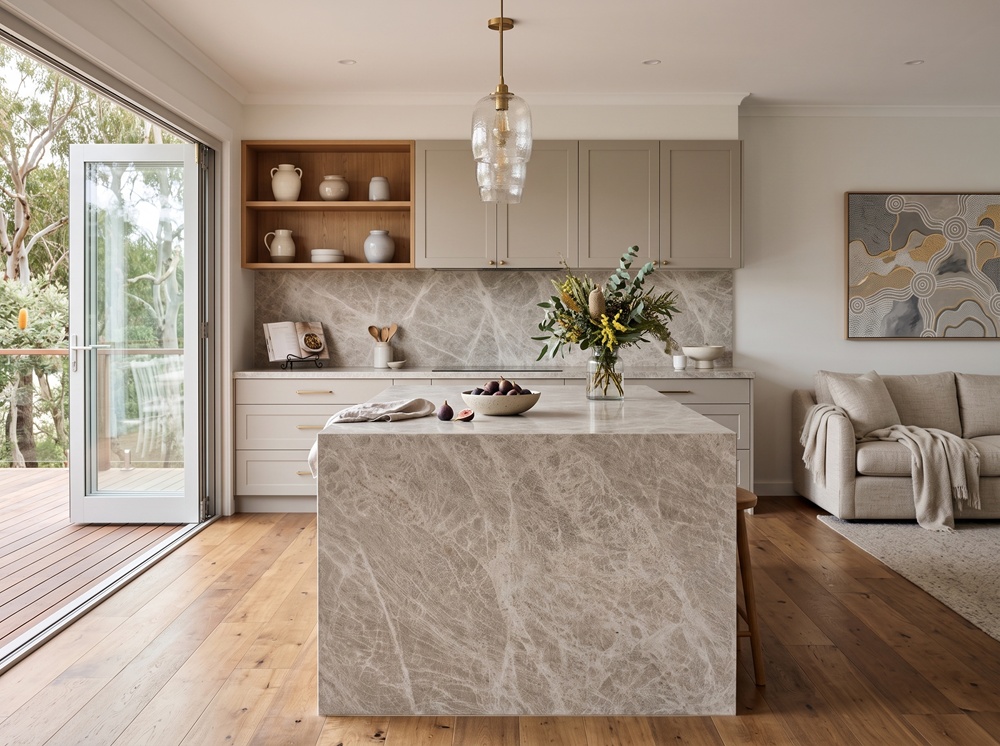
Explore stunning interiors and exteriors showcasing premium marble, granite, travertine, limestone, and porcelain in beautifully designed spaces