
Search products
By name, colour, finish or material — “Bianco Carrara”, “travertine”, “honed”.
If you're planning a kitchen renovation in Australia, one of the hardest items to budget for can be the stone benchtop.
You might find a natural stone slab you love and think you have a good idea of the cost, only to discover that the final installed price is considerably different. You may even receive two quotes for what appears to be the same kitchen and wonder why they're thousands of dollars apart.
The reason is simple: the price of the stone itself is only one part of the finished benchtop cost.
The type of natural stone, number of slabs required, kitchen layout, fabrication, sink and cooktop cut-outs, edge profiles, installation and access to the property can all affect the final price.
This guide explains what actually goes into the cost of a stone benchtop in Australia and what you should consider before requesting quotes.
Unlike buying an appliance with a fixed retail price, a natural stone benchtop is a custom-made product.
Your finished benchtop can involve:
Two kitchens using a similar stone can therefore have very different final costs.
If you're still deciding on a material, start by exploring StoneMart's natural stone products to see the range of colours, patterns and finishes available.
The material itself is one of the biggest variables.
Natural stone isn't manufactured to produce identical colours and patterns. Every slab has its own characteristics, and pricing can vary substantially between different types and varieties of stone.
Common options for kitchen benchtops include marble, granite, quartzite, dolomite and other natural stones.
Even within one category, prices can vary considerably. A relatively common marble, for example, may be priced very differently from a rare stone with distinctive veining.
If you like dramatic natural movement, materials such as Taj Mahal Quartzite can provide a very different appearance from classic marble options such as Bianco Carrara.
Rather than choosing purely by price, consider the appearance, intended application and practical characteristics of the individual stone.
A common budgeting mistake is calculating only the total square metres of the benchtop.
Natural stone is supplied in slabs, and your kitchen layout determines how efficiently those slabs can be used.
A large island, long uninterrupted benchtop, stone splashback or waterfall edge may require another slab even when the additional surface area appears relatively small.
This is why accurate kitchen plans are important when requesting a quote.
A natural stone slab doesn't arrive at your house ready to place on the cabinetry.
It has to be fabricated specifically for your kitchen.
Fabrication can include:
The more complicated the design, the more fabrication may be required.
Your sink and cooktop need to be incorporated into the benchtop design.
An undermount sink, for example, requires the stone surrounding the opening to be carefully cut and finished because that edge remains visible.
Cooktops, taps and other fixtures may create additional fabrication requirements.
When comparing quotations, don't automatically assume these items are included. Ask the fabricator exactly what the quoted price covers.
Different benchtop thicknesses can produce very different visual results.
A slim profile can create a contemporary appearance, while a thicker-looking edge can make the stone appear heavier and more substantial.
However, a thicker appearance doesn't necessarily mean the entire benchtop consists of one solid piece of stone at that thickness.
Mitred edge fabrication can be used to create a thicker visual profile. Because this involves additional cutting, joining and finishing, it can also affect the fabrication cost.
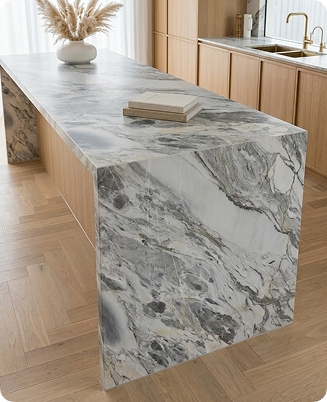
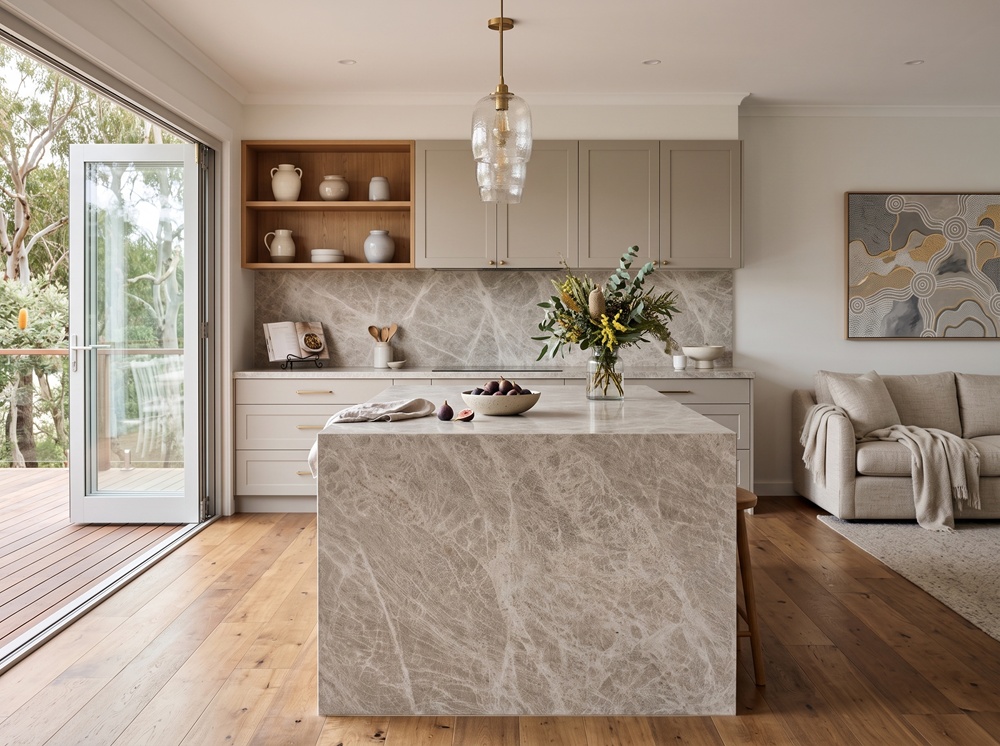
A waterfall edge is created when the benchtop material continues vertically down the side of an island or cabinet.
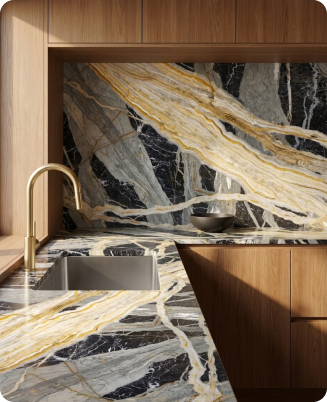
It can be particularly striking with strongly veined natural stone because the pattern becomes part of the overall kitchen design.
However, waterfalls require additional material and fabrication.
If you're considering one, include it in your initial design and quotation rather than adding it after the slabs have been selected.
One of the biggest attractions of natural stone is that every slab is unique.
With strongly veined marble or quartzite, careful fabrication can allow patterns to flow across adjoining surfaces such as the island, waterfall edge or splashback.
Achieving this effect can require careful planning of where each piece is cut from the slab.
It can also mean that maximum material efficiency isn't always possible because appearance rather than minimum wastage becomes the priority.
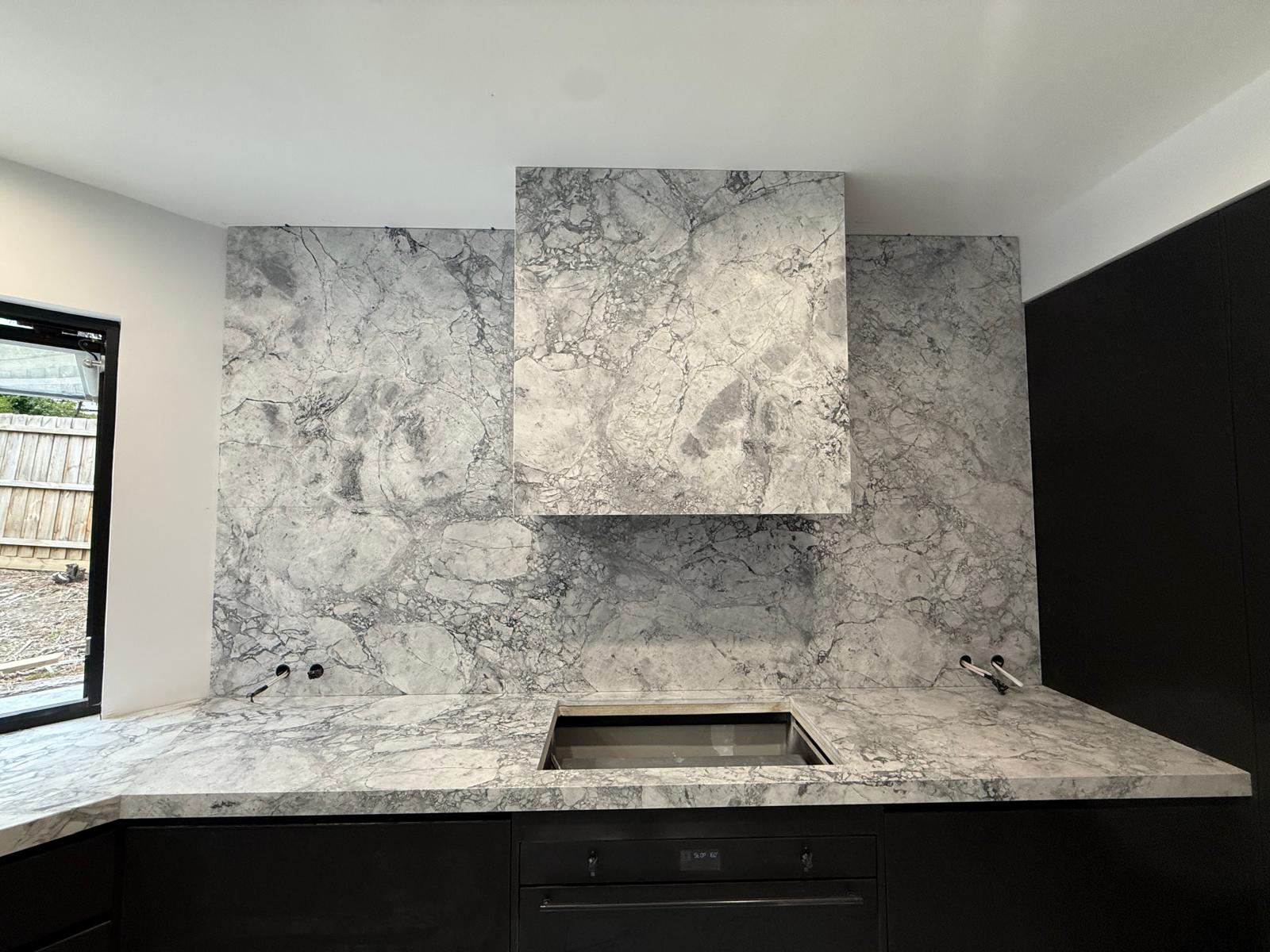
Continuing the same natural stone from the benchtop onto the splashback can create a highly cohesive kitchen design.
However, it also increases the amount of material required.
Depending on your kitchen dimensions, a full-height stone splashback could even increase the number of slabs required for the project.
Make sure your quotation clearly states whether the splashback is included.
Natural stone is extremely heavy and needs to be transported and installed carefully.
Installation can become more complicated when a property has:
These factors may affect installation requirements and ultimately the final cost.
This is one of the most confusing parts of buying a stone benchtop.
You could receive one quote for $8,000 and another for $13,000 and assume one supplier is simply much more expensive.
But before comparing the totals, compare exactly what's included.
Two materials that look similar in photographs can have very different prices.
Different slab layouts and cutting plans can affect the amount of material required.
Don't assume fabrication requirements are included unless they're specifically listed.
A waterfall can materially change both stone usage and fabrication requirements.
A simple polished edge and a more complicated mitred profile don't require the same amount of fabrication.
Make sure you're comparing supply-only pricing with supply-only pricing, or complete supply-and-install pricing with another complete quotation.
A full-height natural stone splashback can significantly affect the amount of stone required.
Comparing these details gives you a much more useful picture than simply selecting the lowest total.
No.
This is one of the most important things to understand when shopping for natural stone.
The price of the raw slab is not necessarily the price you'll pay for your completed kitchen benchtop.
Your finished project may involve:
Stone + fabrication + edge finishing + cut-outs + transport + installation + additional design requirements.
So when comparing materials, try to determine the expected complete project cost rather than focusing only on the slab price.
For a significant natural stone project, obtaining multiple quotations can be worthwhile.
However, every company should be quoting the same specification.
Ideally, provide each fabricator with:
Otherwise, you may unknowingly be comparing completely different scopes of work.
Price shouldn't be your only consideration when choosing natural stone.
Marble is prized for its natural veining and timeless appearance. Because it's a natural material, every slab is different.
It can create a particularly striking result for kitchen islands, splashbacks and statement benchtops.
StoneMart carries a variety of marble options, including distinctive stones such as Calacatta Viola, Volakas and Arabescato Corchia.
Granite is available in a broad range of natural colours and patterns, from relatively subtle designs to dramatic feature stones.
Examples from StoneMart's range include Metalicus Granite and Pretoria Granite.
Quartzite is particularly appealing to homeowners and designers looking for distinctive natural movement.
Options such as Patagonia Quartzite demonstrate how dramatically natural stone can influence the overall character of a space.
Whichever material you're considering, viewing the actual slab whenever possible is valuable because photographs and small samples cannot always communicate the complete pattern of natural stone.
If natural stone will be an important feature of your kitchen, don't leave the selection until the end of the renovation.
Choosing it earlier gives you a better understanding of the overall project budget.
Approximate dimensions allow the supplier and fabricator to determine how many slabs may be required.
Sometimes relatively small changes to a layout can allow slabs to be used more efficiently.
You might love a waterfall island, full-height stone splashback, thick mitred edges and extensive vein matching.
But you don't necessarily need every feature.
If you're working within a particular budget, decide where natural stone will make the greatest visual impact.
Don't automatically select the cheapest quotation.
Make sure you're comparing the same material, dimensions, fabrication requirements and installation scope.
Before committing to your project, ask:
Getting these answers upfront can make comparing quotations much easier.
There isn't one standard price. The final cost depends on the natural stone selected, number of slabs required, kitchen dimensions, fabrication, cut-outs, edge profiles, splashbacks, waterfall edges and installation requirements.
For an accurate figure, obtain a project-specific quotation based on your kitchen plans and selected material.
You're not simply purchasing raw material. A finished natural stone benchtop involves slab selection, planning, specialised fabrication, transportation and professional installation. Rare and distinctive stones may also have substantially different material costs.
Generally, a waterfall requires additional stone and fabrication because the material continues vertically down the end of the cabinetry.
Not necessarily. Always check whether sink, cooktop and tap cut-outs are included in your quotation.
Neither is universally better. The appropriate choice depends on the visual design, selected stone and fabrication requirements. Discuss the intended construction with your stone supplier or fabricator.
Depending on availability and the supplier's process, you may be able to inspect and select the slab. This can be particularly useful with highly patterned natural stone because every slab is unique.
It's useful to understand the fabrication requirements before making a final decision. A fabricator can determine how many slabs your kitchen needs and whether your desired layout can be achieved efficiently.
A natural stone benchtop can become one of the defining features of a kitchen.
Instead of focusing exclusively on a price-per-square-metre figure, consider the complete project: the stone itself, how many slabs are needed, how it will be cut, how the natural pattern will interact with your design, what fabrication is required and how the finished pieces will be installed.
Seeing natural stone used beyond an individual sample can also help when planning a renovation. You can explore StoneMart's completed projects for design inspiration and examples of stone used in finished spaces.
When you're ready to start comparing materials, browse StoneMart's stone collection, or contact StoneMart to discuss the natural stone options available for your project.
Showcase
Explore stunning interiors and exteriors showcasing premium marble, granite, travertine, limestone, and porcelain in beautifully designed spaces