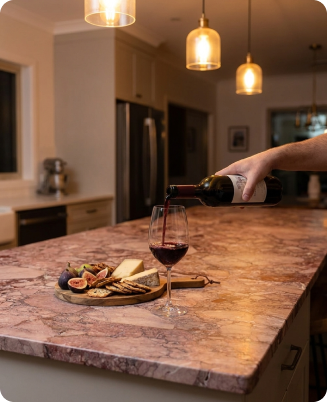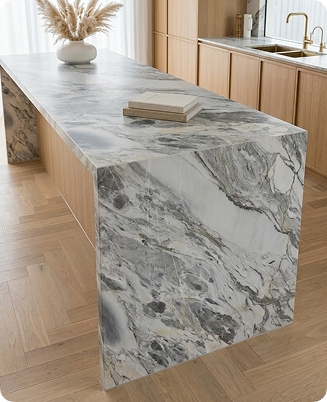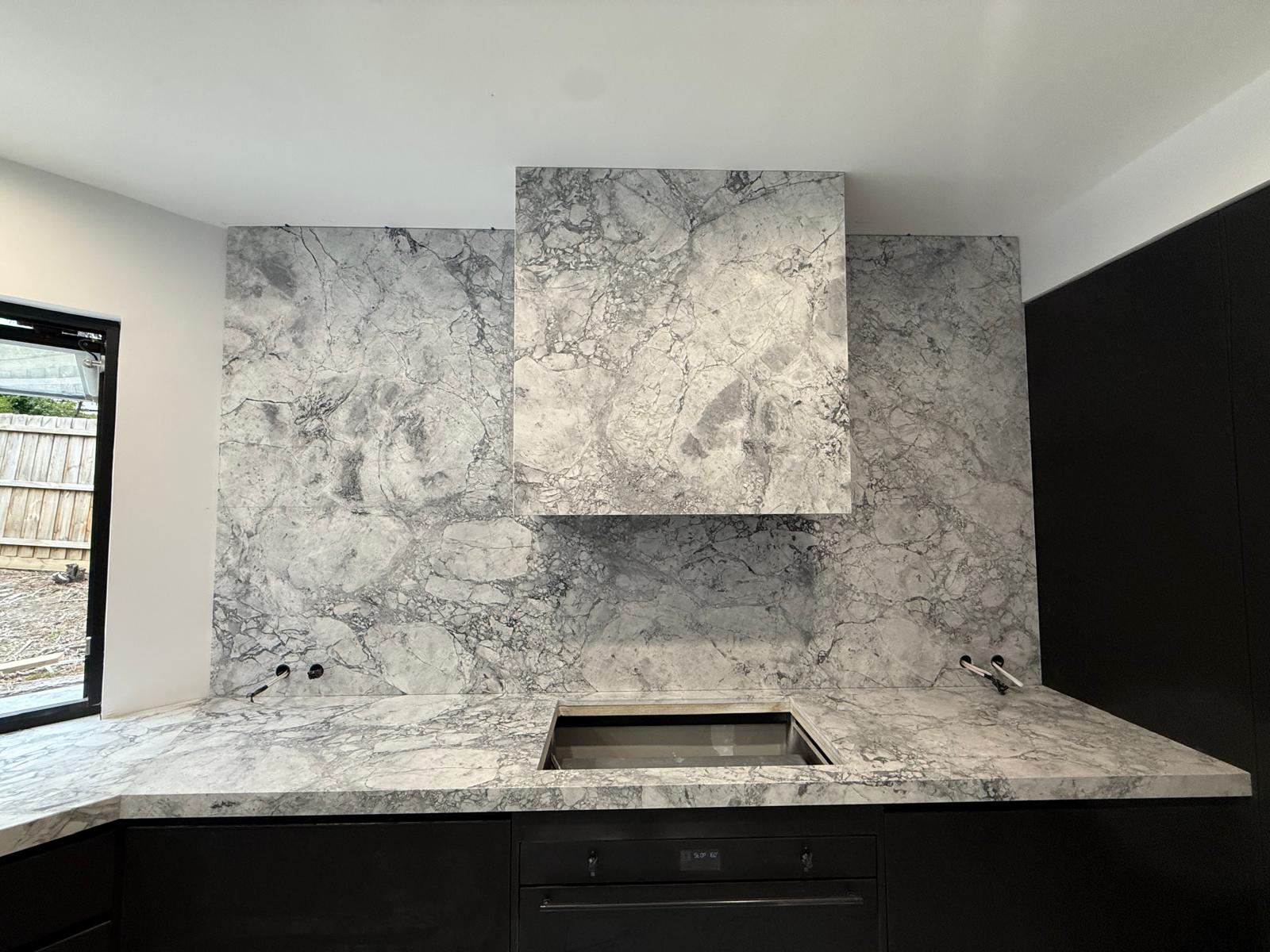

Search products
By name, colour, finish or material — “Bianco Carrara”, “travertine”, “honed”.
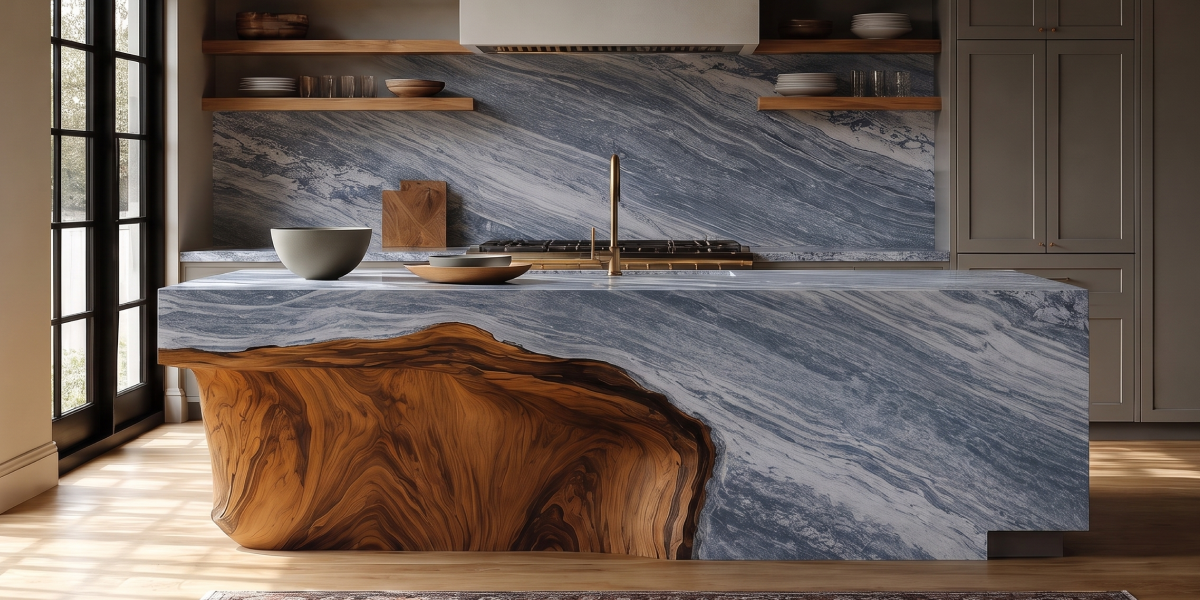
Quartzite has become an increasingly sought-after natural stone for kitchen benchtops, particularly for homeowners who want the movement and character of natural stone combined with a hard-wearing surface.
But if you've started researching quartzite benchtops, you've probably encountered some conflicting advice.
Some homeowners describe quartzite as an exceptionally durable natural stone. Others worry about staining, water marks, sealing and ongoing maintenance. You may also have seen quartzite confused with quartz, even though they are completely different materials.
So, is quartzite actually a good choice for an Australian kitchen?
For the right project, quartzite can be an excellent benchtop material, but the individual stone, its porosity, finish, fabrication and maintenance requirements all matter.
This guide explains what quartzite is, its advantages and disadvantages, what affects quartzite benchtop cost, how to care for it and what to ask before choosing a slab.
Quartzite is a natural stone formed when quartz-rich sandstone undergoes intense heat and pressure over geological time.
This process recrystallises the stone and creates the dense structure associated with quartzite.
Because quartzite is quarried from the earth rather than manufactured, every slab is unique. Colour, veining, movement and other natural characteristics can vary from one slab to another.
Quartzite is available in much more than white and grey. Depending on the minerals present in the stone, slabs can contain cream, beige, gold, green, blue, pink, brown and other tones.
You can browse StoneMart's natural stone collection to compare different stones, colours and patterns available for benchtops and other applications.
No. Despite their similar names, quartzite and engineered quartz are not the same material.
Quartzite is natural stone quarried in slabs from the earth.
Engineered quartz is a manufactured surface made using mineral material combined with other components.
This distinction is important when researching benchtops because advice about cleaning, heat, sealing and maintenance for one material should not automatically be applied to the other.
If you're shopping specifically for natural stone, make sure discussions and care advice you're reading actually refer to quartzite rather than quartz.
One of quartzite's biggest attractions is its combination of natural movement and durability.
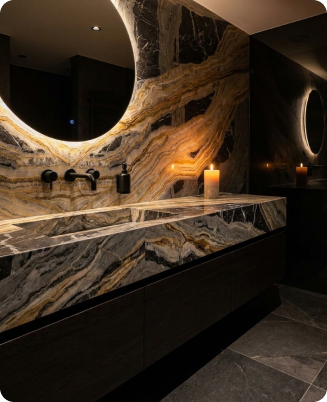
Some varieties feature soft, flowing veins that can provide a marble-inspired appearance, while others have dramatic patterns and colours that become a major feature of the kitchen.
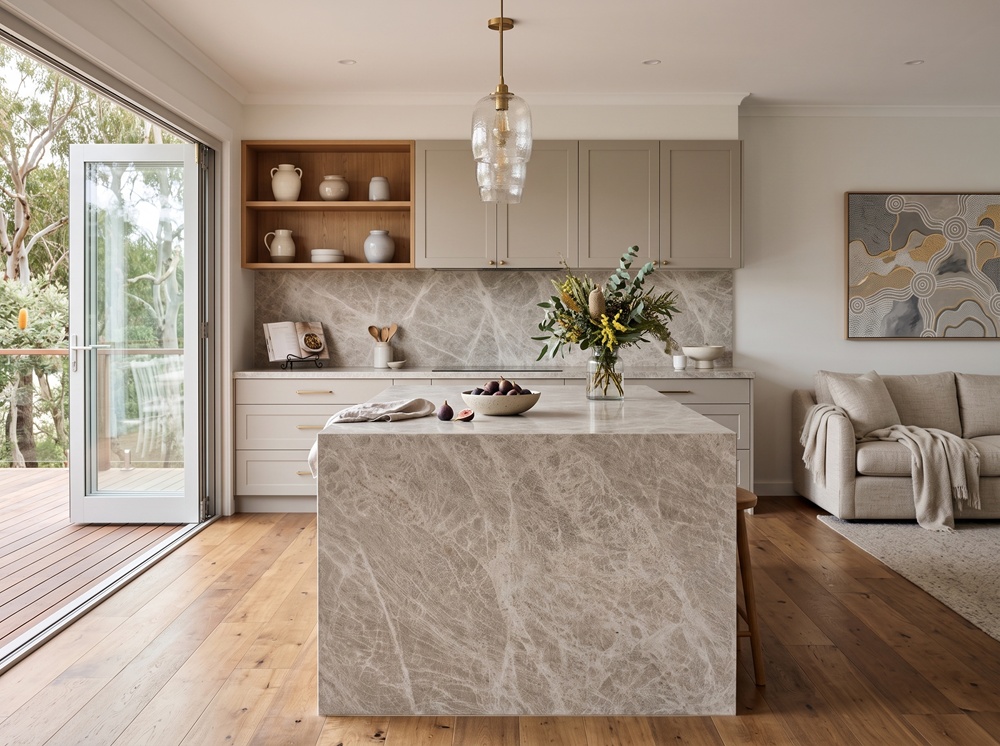
Because each slab is naturally formed, a quartzite island can become a completely individual design element rather than a repeated manufactured pattern.
StoneMart's quartzite range includes options such as Taj Mahal Quartzite, Patagonia Quartzite, Emerald Haze Quartzite and Negresco Quartzite.
Genuine quartzite is known for its hardness.
This makes it attractive for kitchen applications where the benchtop is used every day.
However, a hard surface shouldn't be treated as indestructible. Cutting boards, trivets and sensible everyday care are still recommended for a valuable natural stone benchtop.
For many homeowners, this is the main reason to choose natural stone.
No two slabs are exactly identical.
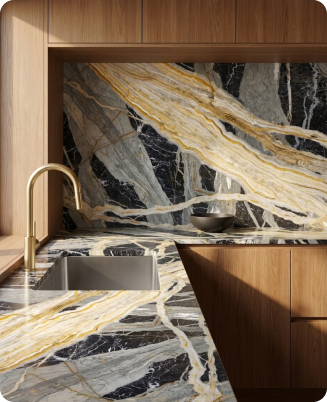
Veining, colour variation and movement can continue across an island, splashback or waterfall edge and become an important part of the kitchen's architecture.
This is especially noticeable with highly expressive stones such as Patagonia Quartzite, where the natural pattern itself can become a feature of the room.
Quartzite doesn't have one standard appearance.
Some slabs are warm and understated, while others contain dramatic movement, strong contrast or unusual colours.
For a softer neutral kitchen, a stone such as Taj Mahal Quartzite may work with warm cabinetry and natural finishes.
For a more expressive design, stones such as Patagonia or Emerald Haze can create a very different result.
Quartzite doesn't have to be limited to a simple horizontal benchtop.
Depending on the slab and project design, natural stone can also be incorporated into:
Using the same slab across adjoining surfaces can create a particularly striking result when the fabricator carefully plans the placement of the natural pattern.
Quartzite has many advantages, but it isn't the right choice for every homeowner.
Natural stone can vary in absorbency.
An appropriate impregnating sealer may be recommended to help reduce the absorption of liquids and make the surface easier to maintain.
However, sealing should not be treated as an invisible shield that makes stone impossible to stain.
The appropriate product and resealing schedule depend on the individual stone, finish, usage and sealer being used.
Rather than following a generic online schedule, ask your stone supplier, fabricator or sealer manufacturer what is appropriate for your specific benchtop.
This is one of the most important points to understand before buying quartzite.
Don't assume that every slab marketed under a similar category will have identical characteristics.
Natural stone varies, and accurate identification matters.
If performance is particularly important to you, discuss the specific slab with an experienced natural stone supplier and fabricator rather than relying only on the trade name.
Even when a surface performs well, a very light benchtop can make crumbs, spills, water residue and everyday marks more visible than a heavily patterned or darker surface.
This doesn't necessarily mean the stone has permanently stained.
For busy households, think about how much visible everyday maintenance you're comfortable with when selecting the colour and finish.
If you expect every part of your benchtop to look identical to a small sample, natural stone may surprise you.
A slab can contain veins, colour transitions, mineral deposits and other naturally occurring characteristics.
For many people, these variations are exactly what make natural stone beautiful.
Whenever possible, inspect the actual slab rather than choosing solely from a small sample or photograph.
Quartzite can potentially stain, but the risk varies with the individual stone, its porosity, finish, sealing and how spills are handled.
This is one of the most common questions homeowners ask when considering quartzite.
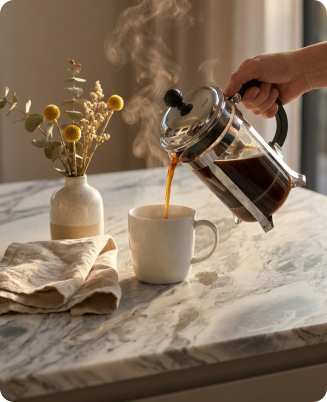
Oil, coffee, wine and other strongly coloured substances shouldn't be intentionally left sitting on a natural stone surface for extended periods.
For everyday use:
If stain resistance is one of your biggest concerns, discuss it before purchasing the slab rather than after installation.
Water marks are another issue frequently discussed by natural stone owners.
Not every visible mark has the same cause. A darkened area could involve moisture absorption, while a dull area visible under reflected light could have an entirely different cause.
This is why treating every mark with random household cleaning products can make matters worse.
If a persistent mark develops, identify the stone and likely cause before attempting aggressive cleaning or polishing.
For significant or unexplained marks, consult your fabricator or a professional stone restoration specialist.
True quartzite is predominantly quartz and is generally resistant to the acid etching associated with calcite-rich stones such as marble.
If a stone sold as quartzite reacts strongly to common household acids, it is worth confirming exactly what the stone is.
This is one reason material identification matters so much when choosing natural stone.
Regardless of stone type, avoid experimenting with acidic or abrasive household cleaners unless they are specifically appropriate for the surface.
Many natural stone benchtops benefit from an appropriate penetrating or impregnating sealer, particularly where the stone has measurable absorbency.
Sealing can reduce water and oil absorption and make everyday maintenance easier, but it does not make natural stone completely maintenance-free.
StoneMart carries stone-care products such as Lithofin MN Stain-Stop, which is designed for stain protection on suitable natural stone surfaces.
Always follow the product instructions and confirm suitability for your specific stone and finish before application.
There isn't one resealing interval that applies to every quartzite benchtop.
You may see advice online recommending sealing every six months, every year or at other intervals. In practice, the appropriate timing depends on factors including:
Follow the recommendations for the actual stone and sealing system used in your kitchen rather than resealing unnecessarily according to an arbitrary calendar.
For routine maintenance, simplicity is generally best.
Clean spills promptly and use products suitable for natural stone.
Avoid reaching automatically for strong acids, abrasive powders or harsh household chemicals because a product that is appropriate for another kitchen surface may not be appropriate for your stone or its finish.
For convenient day-to-day natural stone maintenance, StoneMart also carries Lithofin MN Easy-Clean.
Always follow the manufacturer's directions and confirm compatibility with your particular surface.
Quartzite is a natural stone formed under substantial geological heat and pressure, but that doesn't mean your benchtop should be used as a replacement for a trivet.
Using trivets or heat-resistant mats is inexpensive protection for any premium kitchen surface.
It also protects against risks unrelated to the stone itself, including thermal shock, residues on cookware and accidental scratching.
A hard natural stone surface may resist scratching well, but cutting directly on your benchtop is still unnecessary.
A cutting board protects the surface and, importantly, your knife blades.
For a premium natural stone installation, basic protective habits can help maintain its appearance for many years.
There is no single price for a quartzite benchtop.
The finished cost depends on much more than the name of the stone.
Important factors include:
A rare statement slab used across a large island and full-height splashback will naturally create a different project cost from a smaller kitchen using a more readily available stone.
We've explained these factors in much greater detail in our Australian stone benchtop cost guide.
Taj Mahal Quartzite has become particularly popular for kitchens because of its warm, understated appearance.
Rather than the cooler grey appearance associated with some stones, Taj Mahal commonly combines creamy neutral tones with soft natural movement.
That makes it well suited to kitchens using timber cabinetry, warm whites, beige tones and other natural materials.
Its pattern can provide visual interest without necessarily dominating the entire room.
If you're considering this look, compare Taj Mahal Quartzite NO1, Taj Mahal Quartzite NO2 and Taj Mahal Extra Quartzite.
Because natural slabs vary, viewing the actual available pieces is more useful than assuming every slab carrying the same name will look identical.
Taj Mahal is only one option.
If you want the benchtop to become a stronger design feature, there are quartzites with much more dramatic patterns and colours.
Patagonia Quartzite offers dramatic natural movement and can work particularly well when the stone itself is intended to become a focal point.
Emerald Haze Quartzite provides an alternative for interiors that call for distinctive natural colour rather than a conventional neutral surface.
Negresco Quartzite is another option worth comparing when exploring darker natural stone palettes.
You can also browse the complete StoneMart collection to compare quartzite with marble, granite, dolomite and other natural stones.
Neither material is automatically better for every homeowner.
Marble is valued for its distinctive veining and timeless appearance, but calcite-based marble is sensitive to acidic substances and can develop etching and patina with use.
Genuine quartzite is quartz-rich and considerably harder.
However, appearance, absorbency and maintenance requirements still vary between individual natural stones.
If you love the look of both materials, compare actual slabs and think about how you use your kitchen rather than making the decision solely from photographs.
Both can be excellent natural stone benchtop materials.
Granite has a long history in kitchens because of its durability and broad range of patterns and colours.
Quartzite has become particularly desirable for homeowners seeking the flowing movement found in certain lighter natural stones while retaining the characteristics of a hard quartz-rich material.
The better option comes down to the individual slab, desired appearance, project requirements and your expectations around maintenance.
You can compare quartzite with options such as Metalicus Granite when considering different natural stone directions.
The finish affects both appearance and how the surface feels in the room.
A polished finish reflects more light and can emphasise colour and pattern.
A honed finish has a softer, lower-sheen appearance that can work particularly well in understated contemporary interiors.
Finish can also influence how fingerprints, residue, moisture and everyday wear appear, so don't make the decision purely from photographs.
Ask to see physical examples whenever possible.
Before committing to a slab, ask your supplier or fabricator:
These questions can prevent surprises after fabrication has already started.
Quartzite can be worth considering if you value genuine natural stone, want each slab to be unique and are comfortable following appropriate care recommendations.
It may be particularly attractive if you want your benchtop to become one of the defining visual features of the kitchen.
On the other hand, if your priority is a surface that requires as little thought as possible, discuss your lifestyle honestly with your supplier before choosing any natural stone.
The best benchtop isn't simply the most expensive or fashionable material. It's the material whose appearance and practical characteristics suit the way you actually use your home.
Yes, suitable quartzite can be an excellent kitchen benchtop material because genuine quartzite is a hard, durable natural stone. However, the characteristics of the individual slab, finish, fabrication and maintenance requirements should be considered before purchase.
Not every quartzite behaves identically. Absorbency varies between stones, and appropriate sealing may help reduce staining. Spills should still be cleaned promptly, particularly oils and strongly coloured liquids.
Many natural stone benchtops benefit from an appropriate impregnating sealer. Whether your particular quartzite needs sealing, and how frequently, should be determined from the individual stone and sealing system rather than a universal schedule.
There isn't one correct interval for every quartzite benchtop. The stone, finish, sealer and amount of use all affect maintenance requirements. Follow the recommendations supplied for your particular installation.
Some natural stones can temporarily absorb moisture or develop visible marks. However, not every mark that looks like a water stain has the same cause. Persistent marks should be correctly diagnosed before using aggressive cleaners or restoration methods.
Quartzite is a hard natural stone and genuine quartzite has strong scratch resistance, but no premium benchtop should be treated carelessly. Using cutting boards and avoiding abrasive cleaning methods remains good practice.
Quartzite is formed naturally under substantial heat and pressure, but using trivets for hot cookware is still sensible. It protects the benchtop and avoids unnecessary thermal and surface risks.
Not necessarily. Natural stone prices vary considerably depending on the particular material, rarity, slab dimensions, availability and project requirements. Compare complete fabricated and installed project costs rather than assuming one entire stone category is always more expensive.
Taj Mahal is widely sold in the natural stone market as quartzite and is popular for its warm cream and beige appearance. StoneMart offers several Taj Mahal Quartzite slabs, allowing customers to compare the natural variation between individual pieces.
Yes, whenever possible. Natural stone varies from slab to slab, so viewing the actual slab allows you to understand its colour, veining, movement and natural characteristics before it is cut.
The biggest mistake when choosing quartzite is selecting it purely from an online photograph.
A benchtop is a large part of the visual surface area of a kitchen, and natural stone needs to be considered as an entire slab.
Look at the movement. Consider where major veins could fall. Think about whether you want the stone to quietly complement the cabinetry or become the main feature of the room.
It can also help to explore completed StoneMart projects and see how natural stone works within finished interiors.
When you're ready to compare slabs, explore StoneMart's natural stone collection or contact StoneMart to discuss quartzite options for your kitchen, bathroom or upcoming project.
Showcase
Explore stunning interiors and exteriors showcasing premium marble, granite, travertine, limestone, and porcelain in beautifully designed spaces